
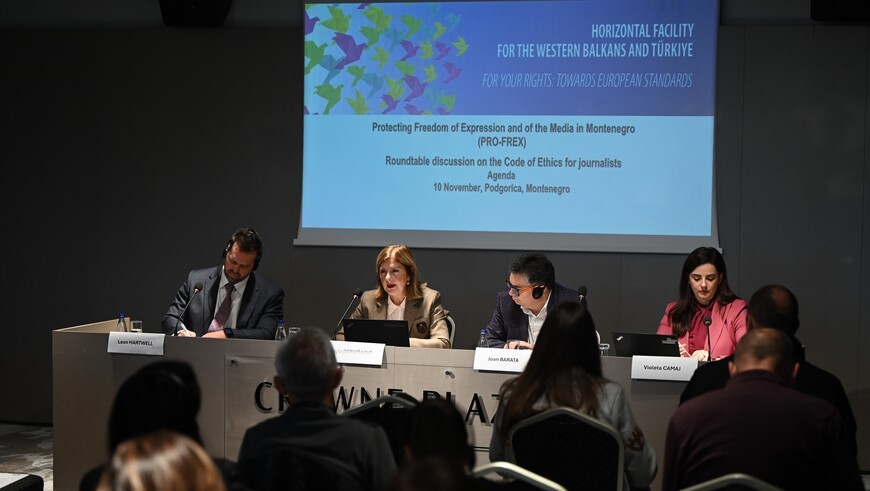
Work on the new Code of Ethics of the Journalists of Montenegro has continued with the presentation of the draft document on November 10 in Podgorica. Work on the additions and changes to the existing Code of Ethics of the Journalists began several months ago, within the working group consisting of domestic media experts, as well as international media expert Joan Barata.
The work on the new text of the Code of Ethics of the Journalists, which was initially adopted in 2002 and improved in 2015, was supported by UNESCO, the OSCE and the Council of Europe. The focus of the Working Group was on the improvement of the Code, considering the development of digital technologies, artificial intelligence and the overall technological development of society. During the work, attention was also focused on hate speech, as well as the right to be forgotten. The attendees gave comments and suggestions to make the document as complete as possible.
The head of the Program Office of the Council of Europe in Montenegro, Lejla Dervišagić, pointed out the most important standards in the field of safety of journalists and the importance of ethical reporting.
International expert on media freedom and self-regulation, Joan Barata, said that the journalism as profession should continuously think about its standards and how to work adequately and professionally.
He said that self-regulation is in the interest of professionals, and that European experience shows that, if there is a good self-regulatory system and if journalists respect ethical and professional standards, the state has fewer temptations to regulate the media.
According to him, there is a good system of self-regulation in Montenegro, along with the existing legal framework. He stated that the existing Code of Ethics is also good, because it includes all the necessary principles, but it needs to be supplemented with new provisions, keeping in mind the development of media and technology.
Barata stated that, if journalists respected the Code, then neither the Government nor other competent authorities would be able to claim that journalists are not professional or that they do not respect standards, and that therefore the state must introduce regulation and thereby exert influence on the media.
"The media council for self-regulation has done its job very well so far, but now a step forward is necessary," said Barata.
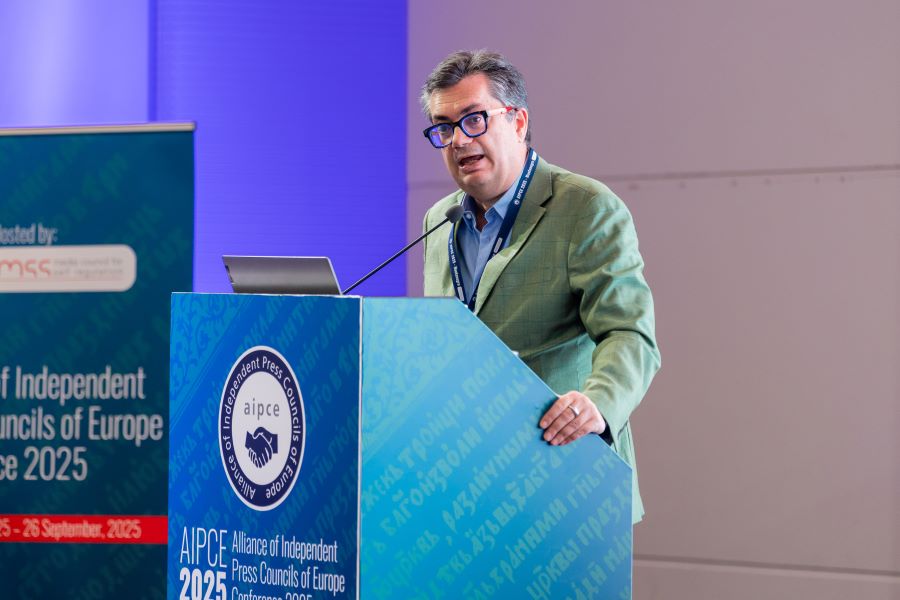
During the work on amendments and changes to the Code, the Working Group gathered a significant amount of material that was used to innovate the existing document and introduce certain changes related to new cases, conditioned by the development of media and technology.
Barata also referred to the process of creating the new document, and said that the experts spoke openly about their concepts, and that the principles and guidelines were specified linguistically, because experience has shown there were problems with the meaning, accuracy and verification of information before.
The new Code will include also topics that were not relevant before, but for which there is an adequate and responsible legal framework today.
Barata emphasized that new criteria were added in the revised Code of Ethics, when it comes to online comments and social networks, but also that there were certain challenges between professional journalism and social networks.
"The Code sets a new, clearer standard when it comes to the use of social networks as a source of information, but it also foresees provisions related to the journalists who use social networks to communicate with the public. I think that this double perspective is very important. The topic of artificial intelligence is extremely important, because this is a new era and the Code now contains special provisions related to it," said Barata.
During the work on the new Code, there was also talk about copyright, with which there are still problems in Montenegro, especially when it comes to their realization. In the media sector, there were a lot of complaints about copyright infringement. "Those affected by this will have legal remedies not only within the law, but also through self-regulation," said Barata.
During the work on the new Code of Ethics of Journalists of Montenegro, there was also talk about copyright, with which there were still problems in Montenegro, especially when it comes to their realization. In the media sector, there were many complaints about copyright infringement. "Those affected by this will have legal remedies not only within the law, but also through self-regulation," said Barata.
One of the important segments worked on in the new Code was hate speech, which had already been defined in the existing Code, but now those provisions were further expanded. Also, the document is now harmonized with the language of international documents, and the new text is much more precise.
The working group has also developed the guidelines related to the reporting about the cases before the court. Journalists must have access to court proceedings, but they need to carefully assess the way in which they report and comment on them. Barata emphasized that it is extremely important to enable the journalists to freely report on all matters of public interest, including court proceedings, but to do so in a precise and accurate manner.
The Code of Ethics of the Journalists of Montenegro should be finalized in the first half of 2026. The comments and suggestions on the draft are still accepted and welcome.