
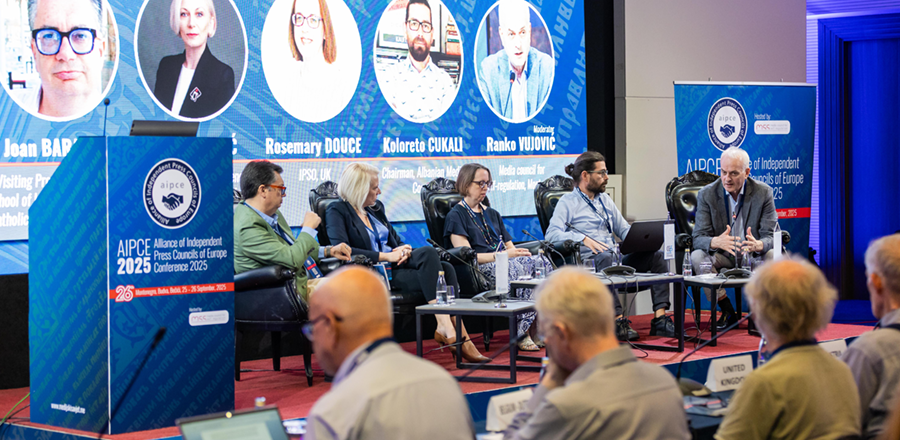
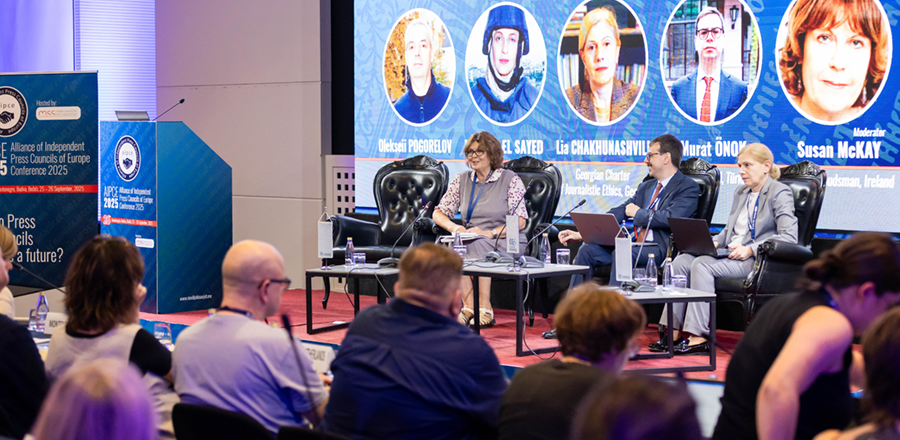
The Media Council for Self-Regulation of Montenegro hosted the 26th annual conference of the Alliance of Independent Media Councils of Europe (AIPCE) entitled "Do media councils have a future?". The gathering was attended by more than 60 participants from 30 countries from three continents, and Montenegro thus became the first country in the Western Balkans to host this prestigious international event.
The conference provided a unique opportunity to share experiences and discuss the future of media advice in the digital age, especially in the context of new European legal framework, including the Digital Services Act (DSA) and the European Media Freedom Act (EMFA).
Media council – a pillar of free journalism
At the panel "Do Press Councils have a future?" participants emphasized the key role of media councils in preserving professional standards and ethics, especially in the digital environment.
The executive secretary of the MSS, Ranko Vujović, emphasized: "Freedom of speech, press and media independence are under pressure, and media councils have an obligation to defend these values."
Media expert Joan Barata said: "Self-regulation remains a key model for protecting professional standards and media independence. Media councils could play an important role in the future as non-judicial dispute resolution bodies and platform partners in the fight against disinformation."
He warns that self-regulation includes all media initiatives aimed at improving ethics and professionalism, and the media and press councils are a pillar of the process.
"It is important to emphasize that self-regulation by definition excludes the role of the state," Barata pointed out, and recalled that the European Court of Human Rights has repeatedly emphasized that states may not determine ethical or professional standards in the media. He warned about the global trend of the so-called "regulated self-regulation", where the state not only defines the code of ethics, but also appoints members of the council or ombudsman.
"It is problematic, because it crosses the red line of direct influence of the state on the system of self-regulation," stressed Barata.
Director of the Agency for Audiovisual Media Services, Sunčica Bakić, emphasized the importance of recognizing self-regulation: "EMFA harmonizes rules that previously existed only for traditional media. The status of a media service can be proven through regulation or membership in a recognized self-regulatory organization. The biggest challenge is malicious actors who refuse registration - an issue that worries regulators across Europe."
Digital challenges and the role of media councils
In the digital age, media councils face new challenges: the spread of misinformation, the growing role of influencers and bloggers, and changes in the way news is consumed.
Koloreto Cukali, president of the Albanian Media Council, said that once everyday life was reduced to buying several daily newspapers, coffee and reading the news: "We have to develop quickly. Today, the entire media landscape is on the phone, the news is shorter and more superficial. The boundaries between classic journalism and new forms of communication are disappearing. Influencers and bloggers produce news - will they become bigger and more influential than traditional media? We have to rethink the role of the press in the digital world."
He recalled that Albania is the first country in Europe without a press, where all media have been moved to the online space, which, as he stated, changes the balance of power because "an individual now has the same power to inform as a large corporation." Most of the complaints received by the Council refer to posts on social networks, primarily on Facebook, over which neither the councils nor the courts have control.
"Not even court decisions have an impact on Facebook. The decision is made, but no one respects it. Media Councils should also be present within the platform. The boundaries between classic journalism and new forms of communication are disappearing. Influencers and bloggers produce news. Will they become bigger and more influential than traditional media? Will we deal with them, too? Or will we say it's not our job?" – asked Cukali.
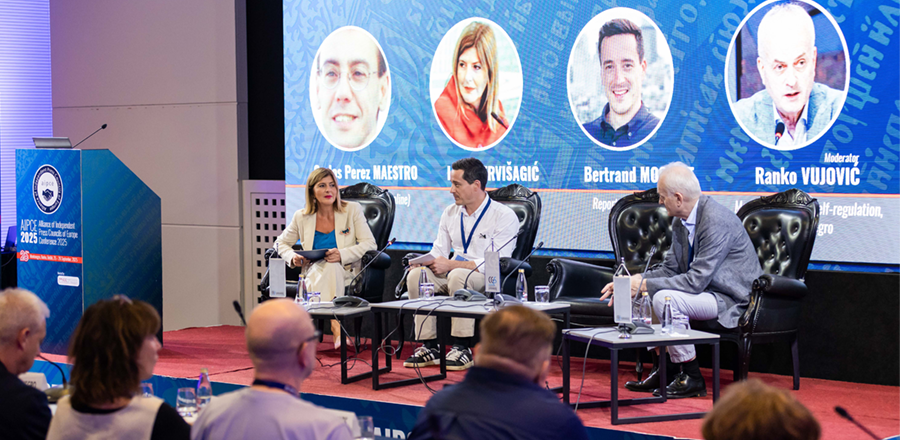
Rosemary Douce from the British IPSO believes that more and more online media want to be regulated, because IPSO is a sign of credibility and responsibility for them. "In the era of disinformation and artificial intelligence, it is important to distinguish between professional journalists and citizen journalists."
IPSO provides guidelines for the responsible use of social media by journalists and plans new guidelines for online comments under articles to ensure accountability and transparency. "The future is in clear rules, so everyone knows their obligations," said Douce.
Caspar Opitz, Sweden's media ombudsman, pointed out: "There are many forces trying to undermine democracy. We, the media councils, are here to defend it. We fight against disinformation, we stand for truth and quality journalism. We must be known, accessible, understandable and completely transparent in the way we work."
Daphne Koene, Netherlands Council for Journalism, presented the TRACK (Transparency, Representation, Awareness, Commitment, Knowledge) model: "The model provides a flexible framework to strengthen the effectiveness of media councils in the EU, increases public trust, encourages active participation of councils in complaints and promotes journalistic literacy."
Media and self-regulation in conditions of war and political pressure
The second day of the conference was dedicated to the topic of journalists under war and political pressure. Oleksii Pogorelov, representative of the Ukrainian Commission for Journalistic Ethics, highlighted the dramatic consequences of the conflict: "The advertising market has almost disappeared, local media are recovering slowly. The largest TV channels and media houses have recovered up to 40% of the market, while local media recorded a recovery of only 10%. About 50% of Ukrainians have left their places of residence, which directly affects subscriptions and distribution of media content. When it comes to news consumption, 75% of Ukrainians follow the news via social networks, most often via Telegram," explained Pogorelov.
He also pointed out that the situation in the media is dramatic - many journalists and editors have died, disappeared or are serving in the army, and the newsrooms are now run by young and inexperienced journalists.
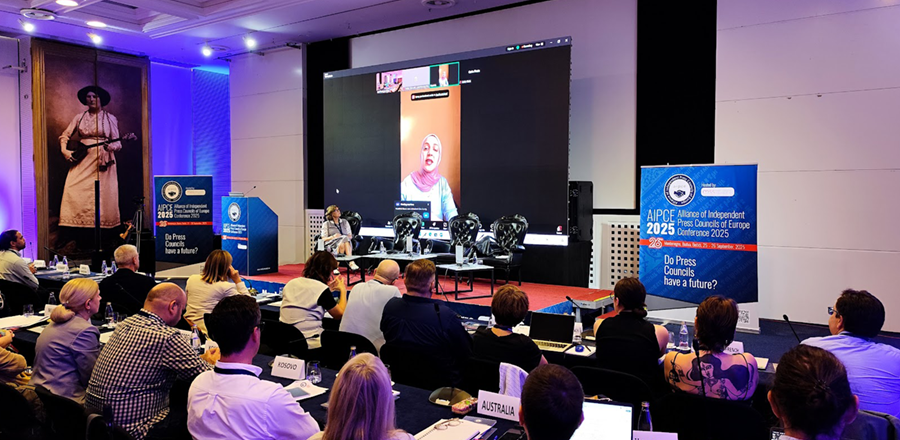
Al Jazeera's correspondent from Gaza, Youmna El Sayed, addressed the participants of the conference through a video message: "In Gaza, the truth is both duty and punishment - journalists work under extreme pressure, but still respect professional ethics," she said, describing the reality that her colleagues face every day. She pointed out that for two years Palestinian journalists had been carrying a burden that no other journalist in the world was forced to carry.
"Unlike foreign journalists, who come to a war zone for a short time and then leave, we had no respite or a sense of security. We have lived the story as we were reporting on it and we are still that story."
She said that journalists reported on the destruction of their own homes, the murder of their families and the displacement of their own and that of their neighbors, friends and colleagues, stating that despite this they remained committed to professional standards: accuracy, fairness, responsibility and humanity. El Sayed believes that the world does not treat Palestinian journalists the same as their colleagues in other countries.
"Palestinian journalists have not received the same justice, solidarity, credibility or protection. The world asks us to be neutral while reporting on genocide. But neutrality, in the face of oppression, is not journalism, it is injustice," said El Sayed.
She pointed out that more journalists have been killed in Gaza in the past two years than in any other war in modern history.
Pressure and attacks in Georgia and Turkey
Lia Chakhunashvili, representative of the Chamber of Journalist Ethics from Georgia, said that the media in that country have been facing serious pressure and attacks since the "Georgian Dream" political party took over power.
According to her, during the last years, after the alleged theft of parliamentary elections, the party took control of key state institutions, including parliament, courts and regulatory bodies. During that period, 25 laws were passed which, as Chakhunashvili believes, create a repressive environment for the media.
"In the last two years, illegal detentions and physical attacks on journalists have been recorded, including the first case in the 35 years of Georgia's independence in which a female journalist was detained as a prisoner. Journalists have suffered hundreds of physical attacks, including serious injuries to the head and facial bones, and none of these cases have been investigated," Chakhunashvili said.
She pointed out that in addition to physical violence, journalists are exposed to negative campaigns, threatening calls, threats to families and vandalism.
"The media that are not close to the government are also facing economic pressures, while the debts of media connected to the government are often forgiven," said Chakhunashvili, stating that new legislative changes make the work of the media even more difficult.
The representative of the Press Council from Turkey, Murat Önok, reminded that that country ranks 159th out of 180 countries in terms of media freedom. The number of jailed journalists, according to the Turkish Union of Journalists, was 17 in July 2025, which Önok said was "good by our standards."
However, as he pointed out, many journalists face charges of terrorism because of the articles they have written or the words they have spoken. Önok explained that Turkey has never been fully successful in terms of freedom of expression and that the current ruling party controls all state institutions.
"The ownership of the media has changed, and the laws that limit the freedom of the media are being applied selectively and arbitrarily," stated Önok.
He also pointed out that Turkey has the second highest number of takedown requests on the internet in the world, stating that access has been blocked for 1.3 million websites.
The success of MSS and international recognition
The Media Council for Self-Regulation of Montenegro demonstrated high standards in the organization of the conference, which was held for the first time in the Western Balkans. Participants praised the professionalism and quality of the event.
Belgian Ombudsman, Pieter Knapen, thanked the Media Council for Self-Regulation for a very interesting and well-organized conference.
"Journalistic ethics and self-regulation remain essential for free and responsible media across Europe," Knapen said.
Alexander Warzilek, from Austria, answering a question posed by the conference, said that media councils have a future: "Of course they do. In times of fake news, media ethics are of particular importance."
Caroline Locher, from the Quebec Medical Council, pointed out that the conference in Montenegro was a fantastic opportunity for media councils from all over the world to gather and cooperate in defending the fundamental values of journalism.
The two-day AIPCE conference in Budva clearly demonstrated that media councils have a key role in preserving media freedom, ethics and professional standards in the digital age. MSS has demonstrated professionalism, international recognition and the ability to organize an event of high international importance.
The participants agreed that self-regulation, with the support of innovative models and international cooperation, remains necessary to combat misinformation, preserve public trust and strengthen democratic values in the media.
The Media Council for Self-Regulation organized the annual AIPCE conference with funds from the Fund for Media Pluralism, which were obtained from the Agency for Audiovisual Media Services (AMU), while the other half was provided from registration fees, and donations from the Municipality of Budva, CGES and Hipotekarna banka. To all those who made this significant logistical and organizational undertaking possible, MSS would like to express its sincere thank you.
Media Council for Self-Regulation